Situation
- The Problem: Biomass and municipal solid waste (MSW) are underutilized energy sources due to high tar production and low conversion efficiency.
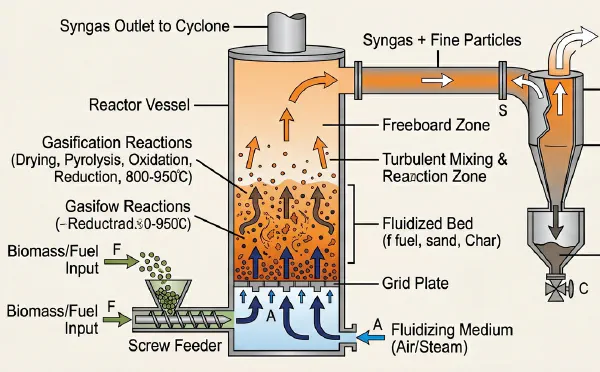
- The Goal: Optimize a 75 KWth bubbling fluidized bed (BFB) gasifier to handle diverse feedstocks (industrial/agricultural waste).
- Environment: Research conducted in the on-site bay using a system funded by a $60,000 NSF EPSCoR grant.
Task
- Design: Integrate a biogas burner into the existing gasification infrastructure.
- Analyze: Evaluate how feedstock variation and reactor hydrodynamics impact cold-gas efficiency.
- Maintain: Ensure project continuity through rigorous data documentation for faculty and future researchers.
Action
- Hardware Engineering: * Designed and installed improvements to a biogas burner as part of a collaborative engineering team.
- Experimental Testing: * Conducted parametric experiments focusing on temperature, bed composition, and fluidization hydrodynamics while analyzing gas chromatography.
- Data-Driven Optimization: * Identified correlations between feed system configurations and tar production levels.
- Knowledge Management: * Drafted technical reports and findings for the Engineering Department Chair.
Result
- Efficiency Gains: Identified specific operating parameters that maximized cold-gas efficiency while minimizing tar.
- System Capability: Successfully upgraded the research platform with a functional burner for synthesis gas combustion.
- Academic Impact: Created a foundational dataset and documentation library used by subsequent student research teams.